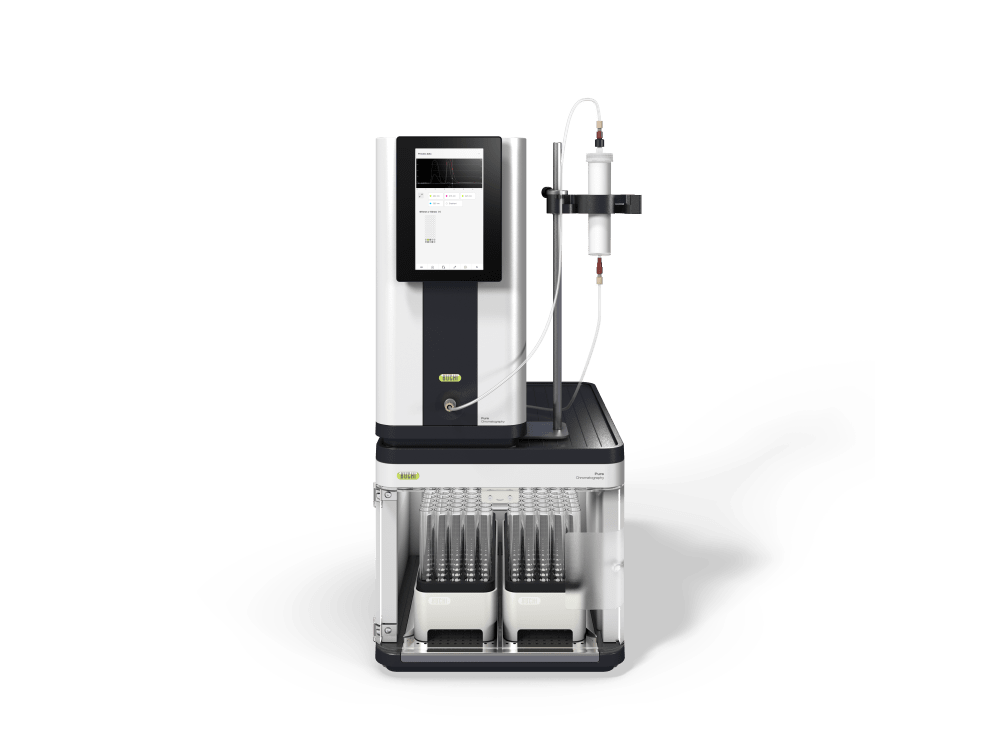
Process intensification with Pure Essential
Pure Essential: comparison with open column chromatography, focusing on separation efficiency, processing time, solvent consumption, and cost-effectiveness.

Chromatography is a fundamental technique in chemical laboratories for separating and purifying compounds from complex mixtures. Among the most commonly used preparative techniques are open column chromatography and flash chromatography. While both rely on similar principles of differential adsorption onto a stationary phase, their performance, efficiency, and cost vary significantly.
This study aims to systematically compare traditional gravity-driven open column chromatography with modern flash chromatography systems, focusing on separation efficiency, processing time, solvent consumption, and cost-effectiveness.
Additionally, different elution strategies (isocratic vs. gradient) and modular configurations of the Pure Essential flash system are evaluated to determine their impact on operational efficiency and return on investment (ROI).
Through a series of standardized separation runs using identical dye samples, this investigation highlights the benefits of modern flash chromatography, offering insights into how labs can optimize their workflows and reduce operational costs.